
October is Menopause Awareness Month, a global campaign led by the International Menopause Society to break the silence around a transition that affects half the population. We wanted to contribute something genuinely useful: a clear, science-backed look at what's changing in your body during menopause and how nutrition can play a supportive role from the day perimenopause starts to the post-menopausal stage.
A note: This isn't medical advice. Haskap isn't a replacement for HRT or any medical intervention. Please speak with your healthcare provider about what's right for you. But understanding the nutritional shifts that happen during this transition can be a powerful complement to whatever path you choose.
The Estrogen Gap
Estrogen regulates your cycle, but it also does so much more, and you may not have noticed how widespread its effects are until you hit perimenopause. Estrogen is a natural antioxidant, an anti-inflammatory agent, a supporter of collagen production, and a protector of cardiovascular health.
During menopause, estrogen declines significantly. But your body's need for all of that protection doesn't decline with it. Demand stays while supply drops. This creates a gap, and that gap is where many menopausal symptoms originate.
What Changes (And Why It Matters)
- Oxidative stress accelerates. Research by Doshi & Agarwal (2013) and Signorelli et al. (2006) shows that postmenopausal women have significantly higher oxidative stress markers. This contributes directly to fatigue, brain fog, skin changes, and reduced immunity.
- Cardiovascular risk increases. Estrogen is cardioprotective. After menopause, women's cardiovascular risk rises sharply. High anthocyanin intake has been associated with reduced heart attack risk in women and improved arterial stiffness and blood pressure, which could help to offset the menopausal increase in risk.
- Collagen loss accelerates. Women lose approximately 30% of their skin collagen in the first five years post-menopause (Brincat et al., 1987), and downing collagen supplements is costly and not always effective. Vitamin C is essential for collagen synthesis, so daily intake supports the body in producing collagen efficiently (Pullar, Carr & Vissers, 2017).
- Inflammation increases. You may have started experiencing joint pain. It’s reported by over 50% of menopausal women. This same inflammation has broader long-term health risks, too.
- Cognitive changes occur. Weber et al. (2014) documented cognitive decline during the menopausal transition. You may have experienced this as brain fog. Anthocyanins cross the blood-brain barrier, and Whyte et al. (2015) demonstrated that anthocyanin-rich berry consumption improved cognitive performance in middle-aged adults.
- Fatigue persists. Up to 85% of menopausal women report fatigue. Oxidative stress damages mitochondria (your cells' energy powerhouses), reducing energy production efficiency.
The Common Thread
These may feel like separate, unrelated problems, but once you understand they are all connected to the same underlying shifts caused by menopause, you can see the bigger picture. Your estrogen is decreasing, and with it, you have increased oxidative stress, rising inflammation, reduced collagen production, and compromised cellular protection.
Consistent daily nutritional support that targets these specific gaps can address multiple symptoms simultaneously.
One Daily Habit That Supports Multiple Symptoms
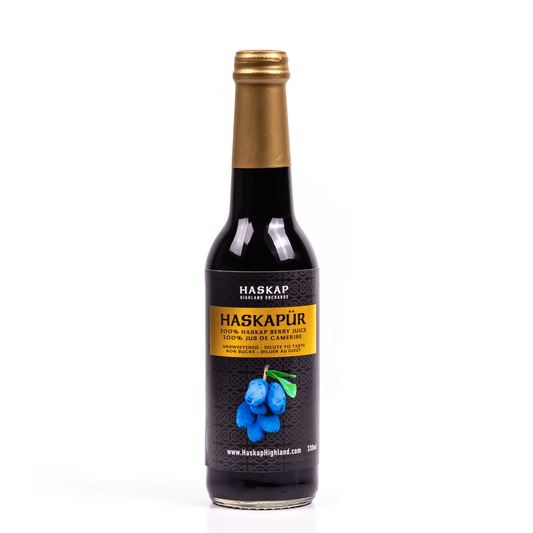
A 60ml shot of Haskapür 100% Pure Haskap Juice delivers concentrated nutrition that directly responds to the changes that arise through menopause:
- Anthocyanins at three times the concentration of blueberries, supporting antioxidant defence, cardiovascular health, inflammation management, and cognitive protection
- Vitamin C for daily collagen synthesis, immune function, and cellular protection (water-soluble, so daily intake is essential)
- Vitamin A for skin repair and immune resilience
- Potassium for cellular energy and fluid balance
- Naturally low sugar so you won’t experience a spike or crash
We grow our Haskap berries in Nova Scotia without pesticides; Nothing added, nothing artificial.
It's not a cure, a treatment, or a replacement for standard menopausal protocols, but it is a daily source of the specific nutrients your body needs more of during this transition. Delivered in five seconds, every morning in a delicious shot.
Menopause Is a Transition
Menopause is a natural part of life. It's not something to "fix," but something to support your body through intentionally, consistently, and with the best information available.
Small choices, made daily, compound over time. They won't eliminate symptoms overnight, but they can meaningfully support your energy, clarity, comfort, and resilience during a period of profound change.
You deserve to feel supported through this. Nutrition is one piece of that puzzle: a simple, consistent, science-backed piece.
Speak with your healthcare provider about your individual needs. And consider whether one small daily habit might complement whatever path you choose.
Shop Haskapür: haskaphighland.com
Find a retailer near you: haskaphighland.com/pages/where-to-buy
Studies referenced in this article
1 Doshi & Agarwal (2013), "The role of oxidative stress in menopause", Journal of Mid-Life Health https://pmc.ncbi.nlm.nih.gov/articles/PMC3952404/
2 Signorelli et al. (2006), “Oxidative stress in post-menopausal women”, Maturitas https://pubmed.ncbi.nlm.nih.gov/16325025/
3 Cassidy et al. (2013), “Anthocyanin intake and myocardial infarction risk in women Circulation”, https://www.ahajournals.org/doi/10.1161/CIRCULATIONAHA.112.122408
4 Jennings et al. (2012), “Anthocyanin consumption and arterial stiffness”, The American Journal of Clinical Nutrition https://pubmed.ncbi.nlm.nih.gov/22914551/
5 Brincat et al. (1987), “Collagen decline following menopause”, Maturitas https://www.sciencedirect.com/science/article/abs/pii/0378512287900454
6 Pullar, Carr & Vissers (2017), "The Roles of Vitamin C in Skin Health", Nutrients https://www.mdpi.com/2072-6643/9/8/866
7 Monteleone et al. (2018), "Symptoms of menopause - global prevalence, physiology and implications", Nature Reviews Endocrinology https://pubmed.ncbi.nlm.nih.gov/29393299/
8 Szoeke et al. (2008), “Musculoskeletal system and menopause”, Climacteric https://www.researchgate.net/publication/5648531_The_relationship_of_reports_of_aches_and_joint_pains_to_the_menopausal_transition_A_longitudinal_study
9 Weber et al. (2014), “Cognition and the menopausal transition”, Menopause https://pubmed.ncbi.nlm.nih.gov/23770320/
10 Whyte et al. (2015), “Berry anthocyanins and cognitive performance”, Nutrients https://www.sciencedirect.com/science/article/abs/pii/S0899900714004353